How London Built Venice in 1891: A Lost Exhibition Marvel
A Venetian Dream Takes Shape at Olympia
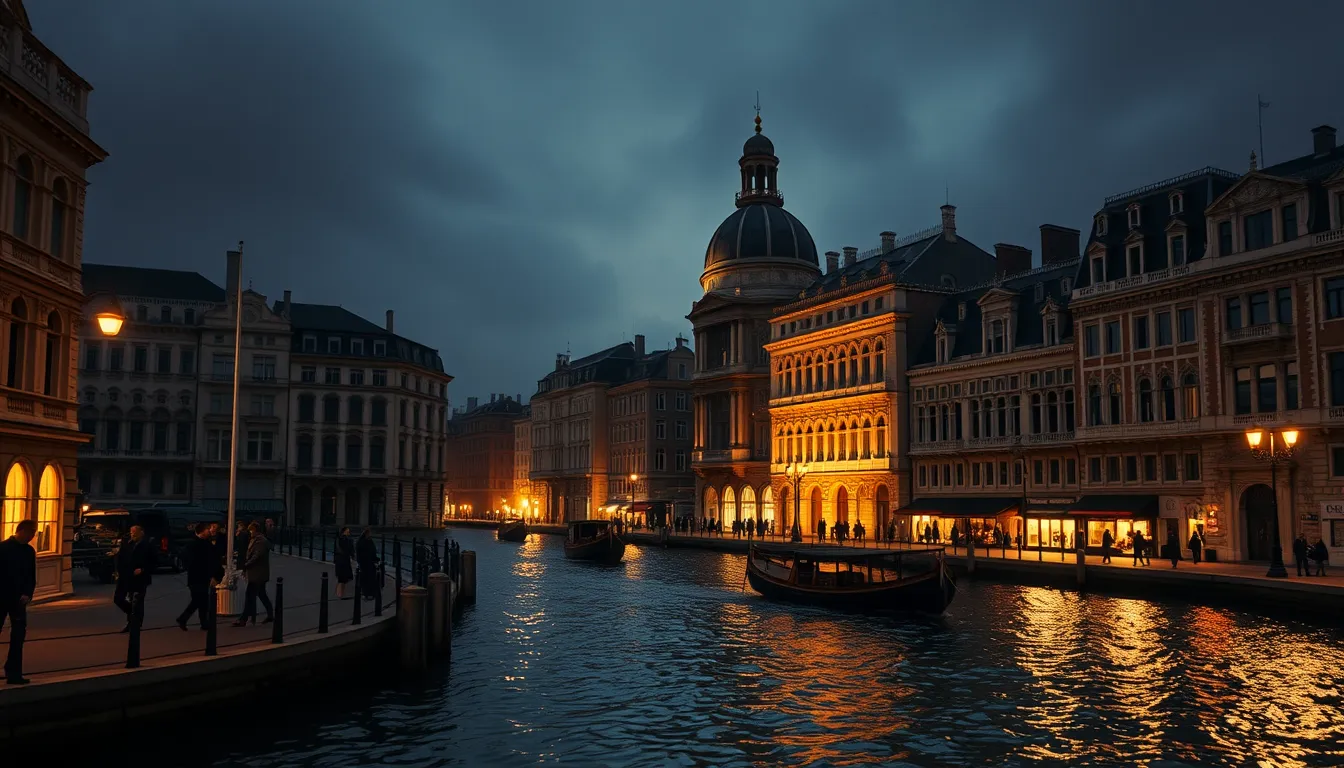
Picture stepping through the doors of Olympia Exhibition Hall on Boxing Day 1891 and finding yourself transported to the Italian lagoon. The scale of ambition was staggering: in just four months, entrepreneurs Joseph Lyons and Harold Hartley orchestrated the creation of an entire Venetian cityscape, complete with functioning gondolas, authentic striped-shirted gondoliers, and architectural replicas of Venice’s most iconic structures. The Grand Canal stretched through the exhibition space, lined with palaces, churches, and campaniles that rivalled the real thing. Visitors could browse Venetian glassworks, admire Italian artworks at dedicated galleries, or relax at the Café Rialto with imported wines and traditional Italian delicacies. What made Olympia—already an established London landmark—the perfect venue was its capacity to handle both the infrastructure demands and the projected crowds. The exhibition wasn’t merely a passive display; it was an immersive experience designed to transport ordinary Londoners somewhere exotic and unreachable for most. This wasn’t just tourism marketing; it was early 20th-century entertainment innovation on a scale London had never witnessed before.
The Grand Spectacle That Captivated Five Million
The true centrepiece was the nightly theatrical production, ‘Venice: The Bride of the Sea’—a dramatic recreation of the 14th century War of Chioggia that would make modern blockbusters blush. Theatre impresario Imre Kiralfy commanded an extraordinary cast of 1,400 performers across triumphal processions, elaborate marine ballets, ship launches, lavish banquets, and gondola regattas. Performers were famously flung from bridges as soldiers in battle sequences. The production budget alone—equivalent to £4 million in today’s money—demonstrated the entrepreneurs’ commitment to authenticity and spectacle. The Times newspaper struggled to convey the visual magnificence, describing it as having ‘gorgeousness from first to last.’ Between 1891 and 1893, approximately five million people visited—roughly twenty times Venice’s entire population at that time. For Londoners who would never afford continental travel, Venice in London offered an affordable glimpse of European grandeur. Both Lyons and Hartley understood the commercial potential: Lyons’ celebrated tea brand and Hartley’s aerated waters were prominently sold throughout the venue, turning the exhibition into a massive product showcase. The venture proved so successful it established the blueprint for experience-driven entertainment venues that would define London culture for generations.
From Exhibition Hall to Corner House Legacy
The impact of Venice in London extended far beyond its thirteen-month run at Olympia. When the exhibition closed in January 1893, it was repurposed into ‘Constantinople,’ another ambitious geographical recreation that demonstrated Londoners’ appetite for armchair tourism. However, Joseph Lyons recognised that his real fortune lay elsewhere. Just a year later, he opened his first dedicated teashop on Piccadilly—a venture that would fundamentally reshape London’s social landscape. This modest establishment became the template for the Lyons Corner House empire, which dominated 20th-century London life and became iconic gathering spaces for generations of Londoners. The vision Lyons demonstrated at Olympia—understanding what people wanted and delivering experiences they couldn’t easily access themselves—proved transferable. His success illustrated how Victorian enterprise, combined with genuine innovation, could create lasting institutions. Today, as you walk past heritage sites near Whitehall and London Big Ben, or visit a London museum exploring Victorian culture, the legacy of these entrepreneurial visionaries remains embedded in how we experience our city. Venice in London may have vanished over a century ago, but it established principles of immersive entertainment and commercial hospitality that shaped modern london attractions and visitor experiences we still enjoy today.
Source: When Venice Was Built In London